
- Retail Insurance
- Business Insurance
- Resources
- Claims


The Royal Enfield Himalayan 450 is one of India's most capable and affordable adventure tourers, built around a 452cc liquid-cooled Sherpa engine producing 40.02 PS and 40 Nm of torque. Designed for both tarmac and off-road terrain, it comes equipped with a 4-inch TFT display with Google Maps integration, 43mm Showa USD front forks with 200mm travel, switchable dual-channel ABS, and a 17-litre fuel tank - all of which make it an ideal machine for long-distance riding and trail exploration.
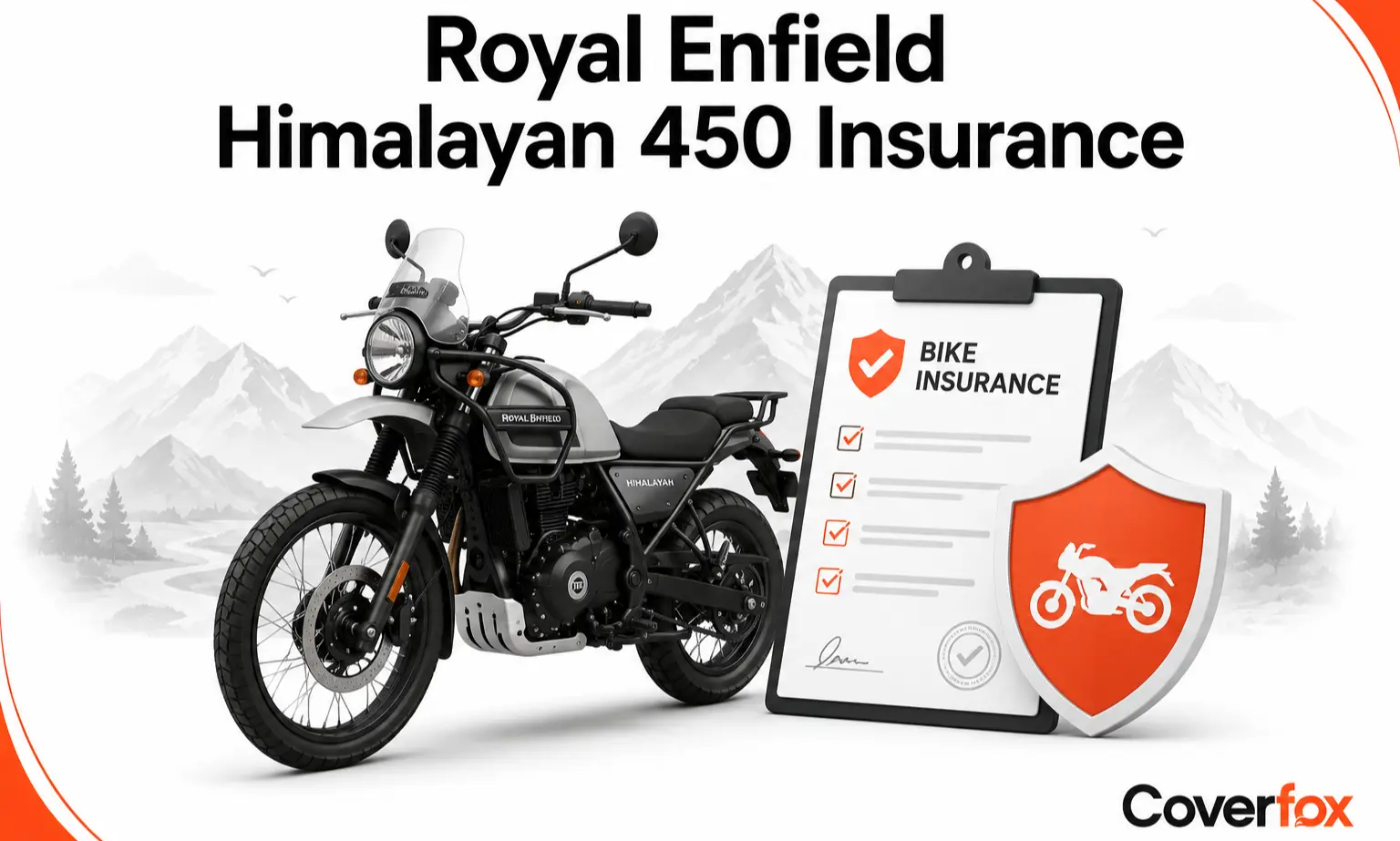
Insuring a Royal Enfield Himalayan 450 is both a legal requirement and a practical necessity. Given the bike's adventure-focused use case - including remote trails, river crossings, and long highway stretches - comprehensive insurance provides broader financial protection than a basic third-party policy alone. Mandatory third-party premiums for the Himalayan 450 stand at approximately ₹2,804 annually, as determined by IRDAI based on the 452cc engine displacement. A full comprehensive policy typically ranges between ₹5,000 and ₹9,000 annually depending on IDV, add-ons, location, and claim history.
| Variant | Zero Depreciation | IDV [1 Year] | Net Premium [5 Years] |
| Himalayan STD 411 CC | ₹288 | ₹1,53,425 | ₹20,497 |
| Himalayan ABS 411 CC | ₹306 | ₹1,62,894 | ₹20,580 |
| Himalayan 450 Pass 452 CC | ₹490 | ₹2,60,823 | ₹21,449 |
| Himalayan 450 Base 452 CC | ₹483 | ₹2,57,213 | ₹21,417 |
Note: Premiums are indicative and vary based on IDV, insurer, registration city, add-ons, and claim history.
A Comprehensive two wheeler insurance combines both third-party liability coverage and own-damage protection under a single policy. For an adventure bike like the Himalayan 450, comprehensive coverage is strongly recommended given its frequent use on unpredictable terrain and remote routes.
Standalone Own-Damage (OD) Insurance covers damages or losses to your own motorcycle resulting from accidents, fire, theft, or natural calamities. It requires a separate active third-party policy to be valid.
Third-Party Bike Insurance is the minimum legal requirement under the Motor Vehicles Act, 1988. It covers liabilities arising from injury, death, or property damage caused to a third party by your bike. It does not cover any damage to the Himalayan 450 itself.
A bike insurance policy for the Royal Enfield Himalayan 450 generally covers the following:
Accidental damage to the motorcycle.
Theft or total loss.
Damage from fire or explosion.
Natural calamity damage (floods, cyclones, earthquakes).
Man-made incidents (riots, vandalism).
Third-party bodily injury or death.
Third-party property damage.
Transit damage during transport.
Normal wear and tear or depreciation.
Mechanical or electrical breakdowns unrelated to an accident.
Riding without a valid driving licence.
Riding under the influence of alcohol or drugs.
Damages from illegal racing or speed trials.
Modifications not disclosed to the insurer.
Damage outside the insured geographical area.
Given the adventure-touring profile of the Himalayan 450, the following add-ons are particularly relevant:
Eliminates depreciation deductions on replaced parts during claims, ensuring a higher net settlement amount. Especially useful for the Himalayan 450's plastic body panels and fibre components.
Covers repair or replacement of the engine and gearbox due to water ingression or oil leakage. Critical for a bike frequently used near water crossings or during monsoon season.
Provides 24/7 emergency support including flat-tyre help, towing, battery jumpstart, and minor on-site repairs - particularly valuable during remote trail rides.
Reimburses costs for consumables such as engine oil, lubricants, nuts, bolts, and washers that are typically excluded from standard claim settlements.
In the event of total loss or theft, this add-on compensates the original invoice value of the motorcycle rather than the depreciated IDV.
Covers the cost of replacing lost or damaged keys and lock sets.
Provides financial compensation to the owner-rider in the event of accidental death or permanent disability. This is a mandatory standalone cover as per IRDAI guidelines.
Have your Registration Certificate (RC), previous policy document (for renewals), driving licence, and KYC documents available before you begin.
Enter your motorcycle's registration number or manually select the Himalayan 450 variant, registration year, and RTO location.
Review available plans from multiple insurers based on premium amount, IDV, add-on options, network garages, and claim settlement ratio.
Choose the policy type and any add-ons relevant to your riding profile. For the Himalayan 450, zero depreciation and engine protection are widely recommended.
Pay securely online using UPI, net banking, or card.
The policy document is issued instantly after successful payment and can be downloaded directly from the platform.
Under cashless claims, the insurer settles repair bills directly with the network garage. The process is as follows:
Notify the insurer immediately after an accident or damage incident, either through the insurer's app, portal, or helpline.
Take the motorcycle to an authorised network garage.
A surveyor will inspect the damage and assess the repair estimate.
Once approved, the garage carries out the repairs and the insurer settles the bills directly.
You are only liable for non-covered components or deductibles, if any.
If the motorcycle is repaired at a non-network garage, you can file a reimbursement claim.
Inform the insurer before initiating repairs.
Get the motorcycle inspected by the insurer's surveyor.
Complete the repairs and retain all original invoices and bills.
Submit the claim form along with the required documents.
After verification, the insurer reimburses the approved claim amount to your bank account.
The following documents are typically required when filing a claim:
Copy of the Registration Certificate (RC)
Valid driving licence of the rider at the time of the incident
Copy of the insurance policy
Duly filled and signed claim form
Repair estimate from the garage
Original repair invoice and payment receipts (for reimbursement claims)
Photographs of the damaged motorcycle
In the event of theft, the following additional documents are required:
First Information Report (FIR) filed with the local police
Final non-traceable report from the police
Original keys of the motorcycle
Original RC and insurance policy documents
Form 28, 29, and 30 (transfer of ownership forms)
No Objection Certificate (NOC) from the RTO, if applicable
Subrogation letter and indemnity bond
Disclaimer: *Discount up to 85% is calculated by comparing different insurers and may vary depending on the insurer, vehicle details, location, and policy terms.
While third-party insurance is the minimum legal requirement, comprehensive insurance is strongly recommended from the start for the Himalayan 450. Given the bike's premium pricing (starting at ₹3.05 lakh ex-showroom) and its adventure-oriented use case, own-damage coverage protects against significant repair costs arising from accidents, falls, flood damage, or theft - all of which are more likely during off-road and long-distance riding.
When you sell the motorcycle, the existing insurance policy can be transferred to the new owner within 14 days of the sale. The buyer is required to inform the insurer and complete the transfer formalities. Any accumulated No Claim Bonus (NCB), however, belongs to the original owner and can be retained by them when purchasing insurance for a new vehicle.
Insurance policies do not specify a mandatory service schedule as a condition for coverage validity. However, damage resulting from poor maintenance or negligence - such as engine failure due to lack of oil - is typically excluded from claim settlement. Following Royal Enfield's recommended service intervals ensures the motorcycle remains in good mechanical condition and supports smoother claim processing.
Standard bike insurance policies in India are valid only within the geographical boundaries of India. Coverage for international rides, including trips to Nepal, Bhutan, or Sri Lanka, requires prior written approval from the insurer or a specific extension of the policy. Riding outside India without such an endorsement means the insurance coverage will not apply.
Yes. If you do not raise any claims during a policy year, you become eligible for a No Claim Bonus (NCB) discount on your own-damage premium at the time of renewal. The NCB starts at 20% after the first claim-free year and can accumulate up to 50% after five consecutive claim-free years. NCB applies only to the own-damage component of the premium and not to the third-party premium.
Yes. The No Claim Bonus is linked to the policyholder and not the motorcycle. If you sell your Himalayan 450 and purchase a new bike, you can transfer the accumulated NCB to the new vehicle's insurance policy. You will need an NCB retention letter or certificate from your existing insurer at the time of purchasing the new policy.

